Paper types and how to choose them for your zine: Understanding basis weight and characteristics
平田提Many people who create zines find that when they finally receive the finished booklet, they feel it's "glossier than expected" or "a bit too slippery." While this might be a pleasant surprise for some, such situations can largely be avoided if you've touched the paper beforehand or ordered with knowledge of paper types and characteristics. Before submitting your print data, take a moment to learn a little about paper.
Understanding "Basis Weight" = Thickness

In the printing industry, the term "basis weight" (斤量, kinryo) is used to express paper thickness. It represents the weight in kilograms (kg) of 1,000 sheets of that paper. A higher number indicates thicker paper.
Strictly speaking, it is also called "ream weight" (連量, renryo) and is used with the same meaning. Basis weight or ream weight notations often appear on printing company order screens.
There is also "grammage" (坪量, tsuboryo), which expresses the weight of paper in grams (g) per square meter.
|
Basis Weight |
Approximate Thickness* |
Main Uses/Characteristics for Zines/Booklets |
|
61.5〜70kg |
Less than approx. 0.08mm |
Text (slightly thin to standard) ・General copy paper is usually around 55-80kg. ・Below 60kg, some paper types may appear translucent. |
|
90kg |
Approx. 0.08mm |
Text (standard) ・This is a standard thickness often used for book text. ・With 90kg or more, show-through is almost nonexistent. ・It's easy to turn pages even for booklets over 100 pages. |
|
110kg |
Approx. 0.10mm |
Text (standard to thick) / Cover (slightly thin) ・Compared to 90kg, it feels sturdier and more substantial. ・Suitable for company brochures, pamphlets, and text of ZINEs with fewer pages. |
|
135kg |
Approx. 0.13mm |
Cover (standard) ・This is a common thickness for zine covers. ・Provides appropriate thickness, durability, and a luxurious feel. |
|
180kg |
Approx. 0.22mm |
Cover (thick) ・Even thicker than 135kg. ・Often used when a more robust cover is desired. |
(*Thickness dimensions are based on values for general coated paper, etc.).
For example, copy paper is usually around 55-80kg. The text of books commonly uses around 90kg. Covers are typically thicker, often 135kg or 180kg.
It's generally standard practice for the cover to be thicker than the text pages. For example, if the text (honmon) is 90kg, you might choose a 135kg cover. If the cover is too thick, it can become difficult to turn pages, so it's best to feel it out in person.
One thing to note is that "the perceived thickness can vary even with the same 90kg, depending on the paper type." It also differs based on the paper's reference size. The tactile sensation of a rough paper (like newsprint) and a high-quality paper at the same basis weight can be quite different. Therefore, you need to consider both the basis weight and the paper type.
With 90kg or more, show-through is almost nonexistent. Below 60kg, some paper types may appear translucent. If your text pages have many photos or solid colors, it's safer to choose a slightly thicker paper.
Differences between Coated and Uncoated Paper
Paper can be broadly categorized into "coated paper" and "uncoated paper."
Coated paper has a coating on its surface, which reflects light and gives it a smooth, slick feel. Photos appear vibrant, similar to magazine glossy pages. It also offers the practical benefit of being water-resistant.

(You can order paper samples from print-on-demand companies or paper suppliers)
Uncoated paper has no coating and is characterized by a rough texture. It reflects less light, making it easier on the eyes. It is often used for book text and zines that are primarily text-based. Risograph printing almost always uses matte-type paper. The ink soaks in easily, creating a distinct texture.
There is also "matte coated paper," which falls between coated and uncoated paper. It offers a balance of moderate gloss and readability, and is often used for catalogs and informational magazines.
Which one you prefer is entirely a matter of taste, but if you don't have an idea beforehand, you might feel it's "not what I wanted" when it arrives. At the very least, decide whether you want a "glossy or non-glossy finish."
Recommended Paper Types for Zines
Here are some commonly chosen papers adopted by many printing companies:
Vellum Nouveau / Arabelle: These are fancy papers with a texture similar to drawing paper. They are high-quality papers often used by professional designers, and using them for a cover immediately improves the tactile experience. The way ink soaks in is unique, giving the printed material a warm feel.
Snow White,
Woodfree paper / Medium-grade paper: These are standard choices for text pages. The name changes depending on the degree of whiteness, but for easy-to-read paper, woodfree paper should be fine.

(Vol. 2 of "How Did Old Office Workers Do Their Jobs?" uses 55kg medium-grade paper. It's risograph printed and slightly translucent, but not to a bothersome degree.)
Matte Coated: If you want to easily achieve a magazine-like feel, matte coated is recommended. It has a smooth texture that makes pages easy to turn, and the residual gloss makes photos stand out.
Awacrème Kinmari (Amber) / Awacrème Rough Book: These are cream-colored, eye-friendly book papers. They are a bit more expensive but have low reflectivity and are suitable for reading long texts.

(The book "I Got a House After Pulling Out a Tree" uses 72.5kg Awacrème Amber. It has some illustrations here and there, but is almost opaque. "Living in Mukonosho" uses 61.5kg Awacrème Rough Book.)
Recycled Woodfree Paper: Made from recycled pulp, this paper is suitable for zines with an environmental focus. It has a texture similar to woodfree paper and is easy to handle.
Depending on the printing company, the available paper types may vary based on whether you choose perfect binding or saddle stitching, or offset printing versus on-demand printing. Please consider these points when making your selection.
・Related Article: Perfect Binding vs. Saddle Stitching: Their Respective Features
・Related Article: Differences between Offset Printing and On-Demand Printing. What is Risograph?
Choose Paper by Touching It
Above all, I recommend actually touching the paper.
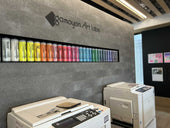
Many graphic printing companies allow you to order paper catalogs after registering as a member (some may charge a fee). Also, Haguruma Printing has showrooms in Tokyo and Osaka. In the Kansai region, there's the "mukku" showroom of the paper company "Niwa Shigyo" in Sakaisujihonmachi, Osaka. Tokyu Hands and Sekaido sometimes display paper basis weights, so you can choose by feeling the texture.
It can be difficult to perceive the texture and feel of paper online. We highly recommend ordering samples or visiting showrooms and stationery stores to physically touch the paper before moving into production. While it may seem like an extra step, this knowledge and experience will surely be valuable for future zine creation!
On the other hand, don't forget the ease of zine creation. A zine handwritten on copy paper also has its own charm. Start by making one, and through trial and error, find the paper you love.
・Related Article: What are paper grain directions (long and short)? For saddle stitching, use short grain (Y-grain) paper.